
Online Reputation Management for Small Businesses
Your reputation is no longer just word of mouth — it's reviews, ratings, business profiles, and how your company responds online. Learn how to monitor conversations, respond with confidence, and turn honest feedback into lasting trust.
Your business reputation is no longer shaped only by what customers say to friends and family. It's also shaped by reviews, ratings, business profiles, social media conversations, photos, comments, and the way your company responds online.
Before calling, visiting, or booking a service, potential customers often search for the business and evaluate what they find. A strong online reputation helps them feel confident. An incomplete profile, unanswered complaints, inconsistent information, or a pattern of negative feedback can send them to a competitor.
Online reputation management helps small businesses monitor these conversations, respond professionally, earn authentic reviews, resolve customer concerns, and build long-term trust. Goodviser gives businesses a place to present their services, communicate with potential customers, publish updates, receive reviews, and develop a visible professional reputation.
What Is Online Reputation Management?
Online reputation management is the process of monitoring and improving how a business is represented across the internet.
It includes much more than collecting five-star reviews. Effective reputation management involves understanding what customers are saying, responding to feedback, correcting inaccurate information, resolving legitimate complaints, and consistently demonstrating that the business is active and trustworthy.
A small-business reputation management strategy may include:
A thoughtful response to a negative review can sometimes demonstrate more professionalism than a page full of generic five-star ratings.
Why Online Reputation Matters for Small Businesses
Large companies can often absorb a few negative reviews because they already have strong brand recognition and thousands of customers. A local business may have only a small number of public reviews, making each one significantly more visible.
A single one-star review has a much greater effect on a business with six reviews than on a company with six hundred. If the complaint remains unanswered, potential customers see only one side of the story.
Reputation is especially important for businesses that depend on trust, appointments, home visits, personal services, or long-term relationships — including:
Customers hiring these professionals aren't simply comparing prices. They're deciding who can be trusted with their home, health, appearance, finances, vehicle, or family. Reputation management is therefore not only a marketing activity — it's also part of customer service and quality control.
How Online Reviews Influence Customer Decisions
Online reviews reduce uncertainty. A company can describe itself as reliable, professional, and experienced, but reviews provide evidence from people who have already used its services. Customers look for proof that a business arrives on time, communicates clearly, charges fairly, delivers on its promises, and treats customers with respect.
Published research on online reviews and purchasing decisions supports the connection between review information and consumer decision-making — reviews are especially influential when customers believe the reviewer had needs similar to their own.
Do
- ✓ Provide a genuinely strong customer experience
- ✓ Invite real customers to share honest feedback
- ✓ Respond to every review professionally
Don't
- ✕ Purchase reviews or create fictional accounts
- ✕ Ask employees to pose as customers
- ✕ Offer rewards specifically for positive ratings
In the United States, deceptive review practices may also violate the FTC's Consumer Reviews and Testimonials Rule. Genuine reviews build lasting trust — manipulated ratings can damage both reputation and credibility.
How to Monitor Your Business Reputation
You can't manage your online reputation effectively if you don't know what customers are seeing or saying. Monitoring doesn't need to be complicated, but it should be consistent — checking reviews only after a complaint can let inaccurate information sit unanswered for weeks.
A practical monitoring schedule looks something like this:
- Check direct messages and inquiries
- Respond to urgent complaints
- Review notifications from active profiles
- Check new ratings and reviews
- Respond to unanswered feedback
- Review social media comments and mentions
- Confirm contact information is accurate
- Search your business name online
- Check for duplicate or outdated listings
- Identify repeated complaints or compliments
- Update photos, services, hours, or announcements
The goal isn't just to watch the star rating — look for patterns. If several customers praise the same employee or process, that strength deserves more visibility in your marketing. If several mention slow callbacks or scheduling problems, that's likely an operational fix worth making.
How to Ask Customers for Reviews
Many satisfied customers are willing to share feedback but don't think about leaving a review unless the business asks. The request should be timely, simple, and neutral — customers should feel invited to describe their genuine experience, not pressured toward a particular rating.
Thank you for choosing [Business Name] for [Service]. We appreciate the opportunity to help you.
Would you be willing to share your experience? Your honest feedback helps our team improve and gives other customers useful information.
[Leave a Review]
Thank you,
[Business Name]
Ask at the right moment — after the repair is tested, the project is approved, or the support issue is resolved. A review request should normally be sent once, with no more than one polite reminder.
Do
- ✓ Provide a direct link to your profile
- ✓ Invite an honest experience, not a rating
- ✓ Give every customer the same opportunity
Don't
- ✕ Ask only for a "five-star review"
- ✕ Write the review for the customer
- ✕ Route unhappy customers away from public reviews
How to Respond to Positive Reviews
Positive reviews deserve more than a generic "Thank you." A thoughtful response shows appreciation, strengthens the relationship, and gives future customers more information about your business. Reference a specific detail, sound natural, and invite the customer back — avoid keyword-stuffed or copy-pasted replies.
The scheduling process was so convenient and the technician arrived right on time. He took his time and explained everything carefully before starting the repair.
Thank you, Maria, for taking the time to describe your experience. We're happy to hear the scheduling was convenient and that our technician arrived on time and explained everything clearly. Your recommendation means a great deal to our team.
Third time using this company and they never disappoint. Consistent, reliable, and easy to schedule with.
Thank you for continuing to choose us, David. We truly value your trust and are glad we could provide another positive experience. We look forward to helping you again.
Keep every response genuine — templates should provide structure, not replace it:
Sounds personal
- "Thank you, Michael. We're glad you were happy with the haircut and the time our barber spent discussing the style with you."
Sounds automated
- "Thank you for your five-star review. We appreciate your business."
How to Respond to Negative Reviews
A negative review will also be read by potential customers evaluating how your business handles problems. A calm, professional response can demonstrate that you listen, communicate responsibly, and take concerns seriously — even when the criticism stings.
Before responding: read the review carefully, check your records, talk to the employees involved, separate facts from assumptions, and decide whether to resolve it publicly or privately. If emotions are high, draft a reply and revisit it later.
Waited almost an hour past the scheduled appointment time with no call to let me know. Frustrating experience.
Hi Jennifer, thank you for sharing your feedback. We apologize for the extended wait and understand how frustrating the delay must have been — this isn't the level of service we want to provide. We're reviewing what happened with our scheduling team and would appreciate the chance to speak with you directly. Please contact [Manager Name] at [Phone Number].
Charged me way more than what I was told over the phone. Not happy about the surprise.
Hi Kevin, thank you for sharing your concerns. We take feedback like this seriously, but some of the details here don't match our records or standard pricing practices. To protect customer privacy, we can't discuss specific account details publicly — we'd appreciate the chance to review this with you directly at [Phone Number or Email].
Acknowledge the concern, briefly clarify when necessary, and move complicated disputes to a private conversation. Never disclose private customer information in a public response.
How to Handle Fake or Misleading Reviews
Not every negative review is fake. A customer may describe an event differently than the business remembers it, misunderstand a policy, or post under a nickname. A review shouldn't be labeled fake simply because it's negative or hard to recognize — but a few signs are worth investigating further:
Before responding or reporting, document the situation privately: a screenshot of the review, the reviewer's profile, the date, and any related invoices or messages.
Most platforms let businesses report content that violates their policies — but removal isn't guaranteed, and it's evaluated against a specific policy, not whether the business finds the review unfair. Never organize retaliation, ask others to attack the reviewer, or disclose their personal information.
How Goodviser Helps Businesses Build Trust
Goodviser gives small businesses and self-employed professionals a place to build a visible online presence and communicate directly with potential customers. Keeping your profile accurate and active helps customers understand what you offer and why they should reach out.
Creating a complete free business listing can help customers understand what your company offers before they ever read a single review. Reputation management works best alongside your local business SEO strategy and ongoing business promotion — visibility and trust reinforce each other.
- Create a professional business profile
- Present services and business information
- Communicate with potential customers
- Answer questions and demonstrate expertise
- Publish news, announcements, and promotions
- Receive customer ratings and reviews
- Build followers and maintain relationships
- Report inappropriate reviews for evaluation
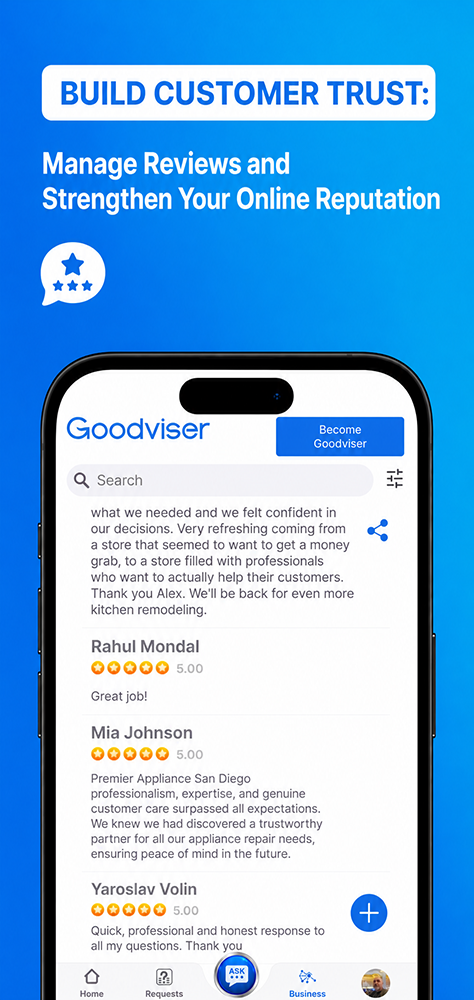
Goodviser doesn't replace good customer service — it provides another place where businesses can demonstrate professionalism and customers can make more informed decisions.
Looking to attract more customers in the first place? See our guide to free business advertising.
Online Reputation Management Checklist
Use this checklist to review and improve your business reputation.
Profile & Information
- Claim and complete your business profiles
- Keep phone, website, address, and hours accurate
- Use a clear, consistent business description
- Add current photos of work, location, or team
Monitoring & Responding
- Monitor new reviews and customer messages
- Respond to positive and negative feedback
- Personalize each review response
- Keep public responses calm and professional
- Move complicated disputes to a private conversation
- Never disclose private customer information
Earning Reviews
- Ask real customers for honest feedback
- Provide a direct review link
- Avoid purchasing or manufacturing reviews
- Avoid rewards tied to positive ratings
Ongoing Practice
- Document suspicious reviews before reporting
- Report content that violates platform policies
- Look for repeated complaints or service problems
- Use feedback to improve business operations
- Publish regular business updates
- Review your online reputation at least monthly
Frequently Asked Questions About Online Reputation Management
What is online reputation management?
Online reputation management is the process of monitoring and improving how a business is represented online. It includes reviews, ratings, business profiles, customer responses, and social media conversations.
Why is reputation management important for small businesses?
Small businesses often depend on local trust, referrals, and repeat customers. Reviews and business profiles can influence whether a potential customer contacts the company or chooses a competitor.
How often should a business check its reviews?
Businesses receiving frequent feedback should check reviews several times per week. At minimum, reviews, messages, and important listings should be checked weekly.
Should businesses respond to every review?
When practical, yes. Responses show that the business is active and values customer feedback, for both positive and negative reviews.
How quickly should a business respond to a negative review?
Most negative reviews should be reviewed and answered within 24–48 hours. The business should first investigate the situation and avoid responding emotionally.
What should a business say in response to a negative review?
Acknowledge the concern, remain respectful, clarify briefly when necessary, and invite the customer to continue the conversation privately. Don't argue or disclose confidential information.
Can a business remove a negative review?
A business generally can't remove a legitimate review simply because it's unfavorable. Reviews may be reported when they violate a platform's policies, but removal is determined by the platform.
What should a business do about a fake review?
Document the review, check internal records, respond carefully, and report it under the most accurate policy category. Avoid publicly accusing the reviewer without clear evidence.
Is it acceptable to ask customers for reviews?
Yes. Businesses can invite real customers to share honest feedback. The request should be neutral and shouldn't pressure a particular rating.
Can a business offer a discount for a review?
The safest approach is to avoid incentives. Many platforms prohibit rewards in exchange for reviews, and incentives connected to positive feedback can create compliance problems.
What is review gating?
Review gating is encouraging satisfied customers to post public reviews while directing dissatisfied customers to a private channel. Businesses should give every genuine customer an equal opportunity to share feedback.
Should a business use response templates?
Templates can help maintain structure, but every response should be personalized. Repeating the same message under every review can make a business appear inattentive or automated.
Can one negative review damage a business?
Not necessarily. The effect depends on the number of reviews, the nature of the complaint, and how professionally the business responds.
How can a business improve its online reputation?
Provide dependable service, maintain accurate business information, request authentic feedback, respond professionally, publish useful updates, and fix recurring service problems.
How can Goodviser support a business's reputation?
Goodviser allows businesses to create a professional profile, present their services, communicate with potential customers, publish updates, answer questions, and receive customer ratings and reviews.
Build a Reputation Customers Can Trust
A strong reputation isn't created by collecting as many five-star ratings as possible. It's built through reliable service, honest communication, authentic feedback, and responsible responses when something goes wrong. Goodviser helps you present your services, share professional knowledge, and build a visible record of trust.